
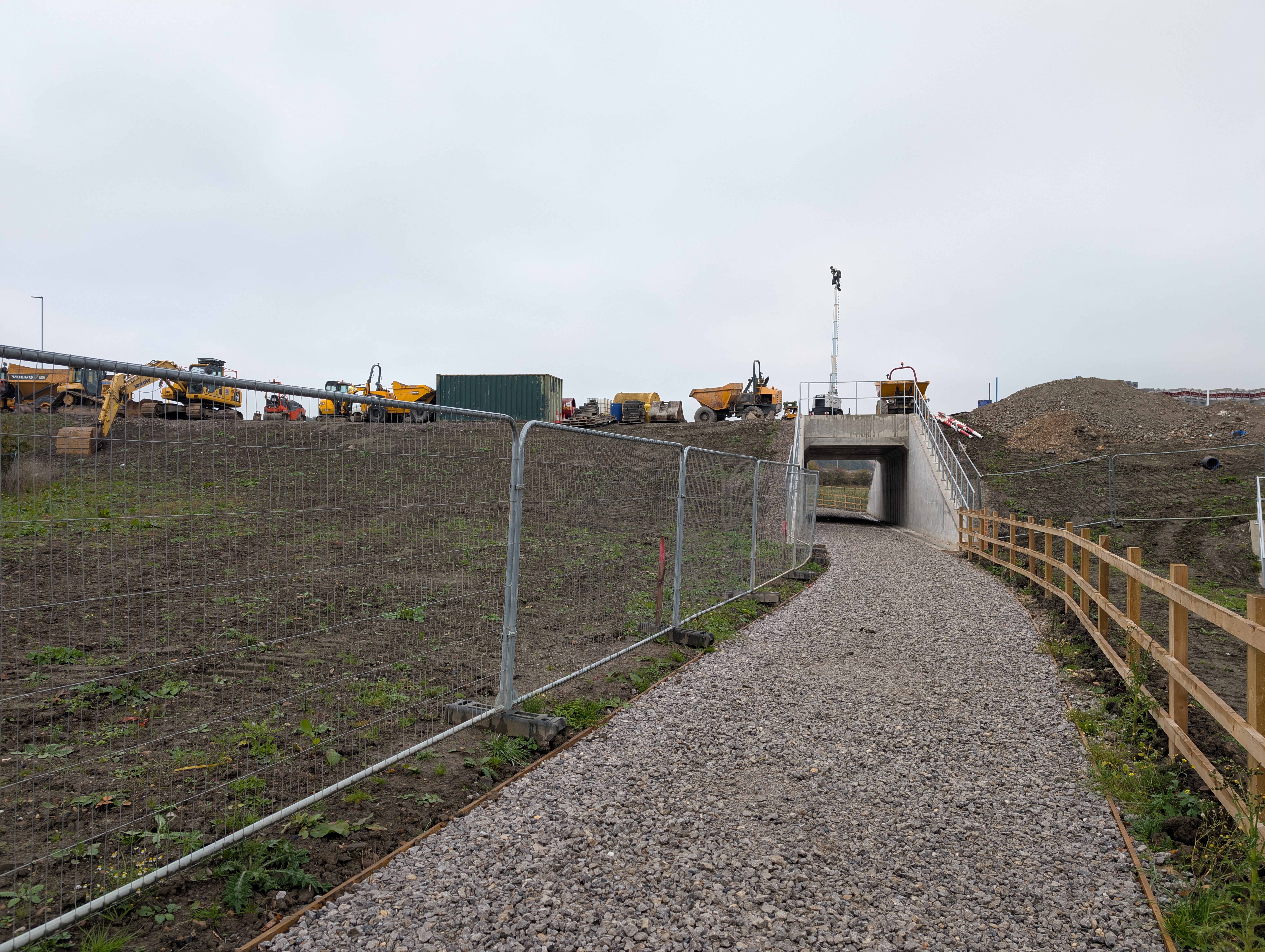
The new National Planning Policy Framework for England was published on 17 August 2026. There are plenty of headline changes in its 130 pages, but one that will be particularly important for anyone working with public rights of way is NPPF Policy TR8. The NPPF applies only in England; planning and access policy is different in Wales, Scotland and Northern Ireland.
Public rights of way have not suddenly appeared in national planning policy for the first time. The previous Framework already said that planning policies and decisions should protect and enhance public rights of way and access. However, TR8 gives the subject its own national decision-making policy and sets out, in much clearer terms, what development proposals are expected to do.
That matters because public rights of way are too often picked up late in the planning process, once a layout has been designed and the route is treated as a line that needs to be moved out of the way. TR8 should encourage a much earlier and more useful conversation about how a route fits into the development and the wider network around it.
What does NPPF Policy TR8 say?
Policy TR8 appears in Chapter 15 of the new NPPF, which deals with promoting sustainable transport. In summary, it says that development proposals should:
- protect and enhance the public rights of way network, including by using suitable diversions agreed with the highway authority; and
- take opportunities to extend, connect or improve existing routes where this would improve access to green space and the countryside, create useful direct or circular routes, provide accessible and convenient links to facilities, or improve connections with public transport.
The wording is important. The policy is not limited to preventing the loss of an existing route. It asks how development can leave the network better connected and better able to serve the people who will use it.
The policy applies to the network of public rights of way as a whole. Although one part of TR8 refers specifically to connections between footpaths, bridleways and cycle routes, restricted byways and byways open to all traffic are also public rights of way and should not be overlooked when a site or its wider connections are assessed.
Why is TR8 different from the previous NPPF?
Paragraph 105 of the December 2024 Framework already contained a general requirement to protect and enhance public rights of way and access, including by adding links to the existing network. TR8 carries that principle forward but gives it more substance.
Four changes are particularly significant.
First, TR8 is a specific national decision-making policy. The new Framework confirms that these policies are material considerations which should be read alongside the development plan. The Government also confirmed that the new decision-making policies came into effect immediately on 17 August 2026. Therefore, TR8 is relevant to planning applications being determined now, not only to future local plans.
Second, the policy expressly recognises that a diversion may be acceptable. That is a sensible acknowledgement that development and the existing legal line of a route will not always fit neatly together. However, the diversion must be suitable and agreed with the highway authority. This should put the quality of the proposed route, and early engagement with the public rights of way team, much closer to the centre of the design process.
Third, the policy looks beyond the boundary of the application site. A new path that ends at the site entrance without connecting to anywhere useful is not much of an enhancement. TR8 instead directs attention towards the wider network: green spaces, countryside access, local and long-distance routes, services, facilities and public transport.
Finally, the express reference to accessible, safe and convenient links is welcome. A route can exist on paper and still work poorly in practice because of its width, gradient, surfacing, road crossings, barriers or lack of onward connections. Accessibility should now be part of the conversation from the start rather than something considered once the main layout has already been fixed.
“Protect and enhance” is more than keeping a line on the plan
It is quite common for a planning layout to show the approximate line of a public footpath and assume that this means the route has been dealt with. In reality, protecting a public right of way requires a better understanding of how the development will affect the route during construction and once the development is occupied.
That includes questions such as:
- Is the definitive legal line shown accurately on the plans?
- Will the route remain open, safe and usable while work takes place?
- Will new roads, driveways, drainage, landscaping or changes in level affect it?
- Is the route’s legal status reflected in the design and are the needs of all lawful users being considered?
- Will the finished route still feel attractive and convenient, or will it be squeezed between fences and buildings as an afterthought?
- Are there opportunities to improve the route’s width, surface, accessibility or connections without changing its character unnecessarily?
Enhancement will not mean the same thing on every site. A surfaced urban link to a school or bus stop may need a very different approach from a rural bridleway or restricted byway. The starting point should be the route, its setting, its lawful users and the role it plays within the wider network—not a standard path detail applied everywhere.
What does NPPF Policy TR8 mean for diversions?
The reference to suitable diversions is helpful, but it does not make the legal process disappear. Planning permission does not, by itself, divert or extinguish a public right of way. Nor does an indication that a diversion is acceptable in planning terms guarantee that the necessary public path order will be made and confirmed.
Where a footpath, bridleway or restricted byway needs to be diverted or stopped up to enable development, a separate order may be required under section 257 of the Town and Country Planning Act 1990. Other powers may apply in different circumstances. Until the relevant legal process has been completed and the order has come into effect, the existing route remains the public right of way.
In practical terms, that means the proposed diversion needs to be considered before the site layout is fixed. Its width, gradient, surfacing, structures, connections, amenity and effect on users should be understood early. Land ownership must also be checked, and the programme should allow for consultation, objections and the possibility that an order may take considerably longer than expected.
The phrase “agreed with the highway authority” should not be read as an informal substitute for the order process. Instead, it reinforces the need for early discussions with the authority’s public rights of way officers so that an unsuitable diversion is not designed into an otherwise advanced scheme.
A stronger basis for securing useful connections
One of the most positive parts of TR8 is its focus on extending and linking the network. New development can create real opportunities to fill short gaps, connect existing paths, provide circular routes and make it easier to reach schools, shops, workplaces, green spaces and public transport without relying on a car.
This is particularly important where a site is close to an existing route but does not actually connect to it, or where a development could provide a missing link between two parts of the network. It also gives planning authorities a clearer national policy basis for asking whether a proposal has taken reasonable opportunities to improve local walking, wheeling, cycling and, where appropriate, equestrian or carriage-driving connections.
There is still some room for interpretation. TR8 does not say that every development must dedicate a new public right of way, and any planning condition or obligation must still meet the usual legal and policy tests. The final wording also does not expressly refer to section 106 contributions, despite respondents to the consultation asking for developer contributions to be given greater emphasis. Nevertheless, the policy makes it harder to dismiss network improvements as unrelated extras where there is a clear connection to the development.
What should developers and landowners do now?
For developers, landowners and their advisers, the practical answer is to identify rights of way at the very beginning of a project. That means checking the definitive map and statement, but it should not end there. The site should also be checked for paths in use, pending definitive map modification applications and other evidence which could indicate that an unrecorded public right may be an issue.
Once the baseline is understood, the public rights of way network should help shape the layout. If a diversion is being considered, there needs to be a clear reason for it and a proposed route which works for users as well as for the development. If an enhancement or new connection is possible, it is much easier to accommodate it before land budgets, drainage, landscaping and access arrangements have all been fixed.
Early work may feel like another task at the front end of a planning application, but it is usually far less costly than redesigning a scheme or trying to resolve a public path order problem once permission has been granted and contractors are ready to start.
What should planning and highway authorities look for?
For local planning authorities and highway authorities, TR8 provides a clearer basis for joined-up working. A planning case officer should not have to work out the effect on the rights of way network without specialist input, while the public rights of way team needs enough time and information to assess the legal route, the proposed design and the wider opportunities.
Authorities will need to look beyond whether a path is technically retained. A proposal may keep the route on its existing line but still make it less safe, attractive or convenient. Equally, a carefully designed diversion could improve accessibility or connections while retaining the character and enjoyment of the route. The assessment should be based on the actual consequences for the network and its users rather than an assumption that retaining or moving a line is automatically the better option.
Is NPPF Policy TR8 a major change for public rights of way?
TR8 is not a complete change of direction, because the previous NPPF already required public rights of way to be protected and enhanced. It does not override highways legislation, guarantee that a diversion will succeed or require a new route to be created on every development site.
Even so, having a dedicated and more detailed national policy is significant. The Government’s response to the consultation says that TR8 was strengthened because of the importance of public rights of way to active travel and community wellbeing. Of the 671 people and organisations that answered the relevant consultation question, 72% strongly or partly agreed with the proposed policy.
The real test will be how consistently it is applied. If TR8 leads to earlier assessment, better engagement with highway authorities and routes which are designed as part of a connected network, it will be a useful step forward. If it becomes another paragraph cited in a planning statement after the layout has already been settled, much of that opportunity will be lost.
Public rights of way are infrastructure. The new NPPF gives everyone involved in development a clearer reason to treat them that way.
Public rights of way advice for development projects
CD Access Consultancy works with developers, landowners, land agents, planning professionals and local authorities on public rights of way affected by development. This can include early site reviews, route and network assessments, diversion strategies, accessibility advice, consultation support and public path order work.
If a site is crossed by, next to or potentially affected by a public right of way, getting specialist advice before the layout is fixed can save a great deal of difficulty later. Please get in touch to discuss how CD Access Consultancy can help.

Leave a Reply